
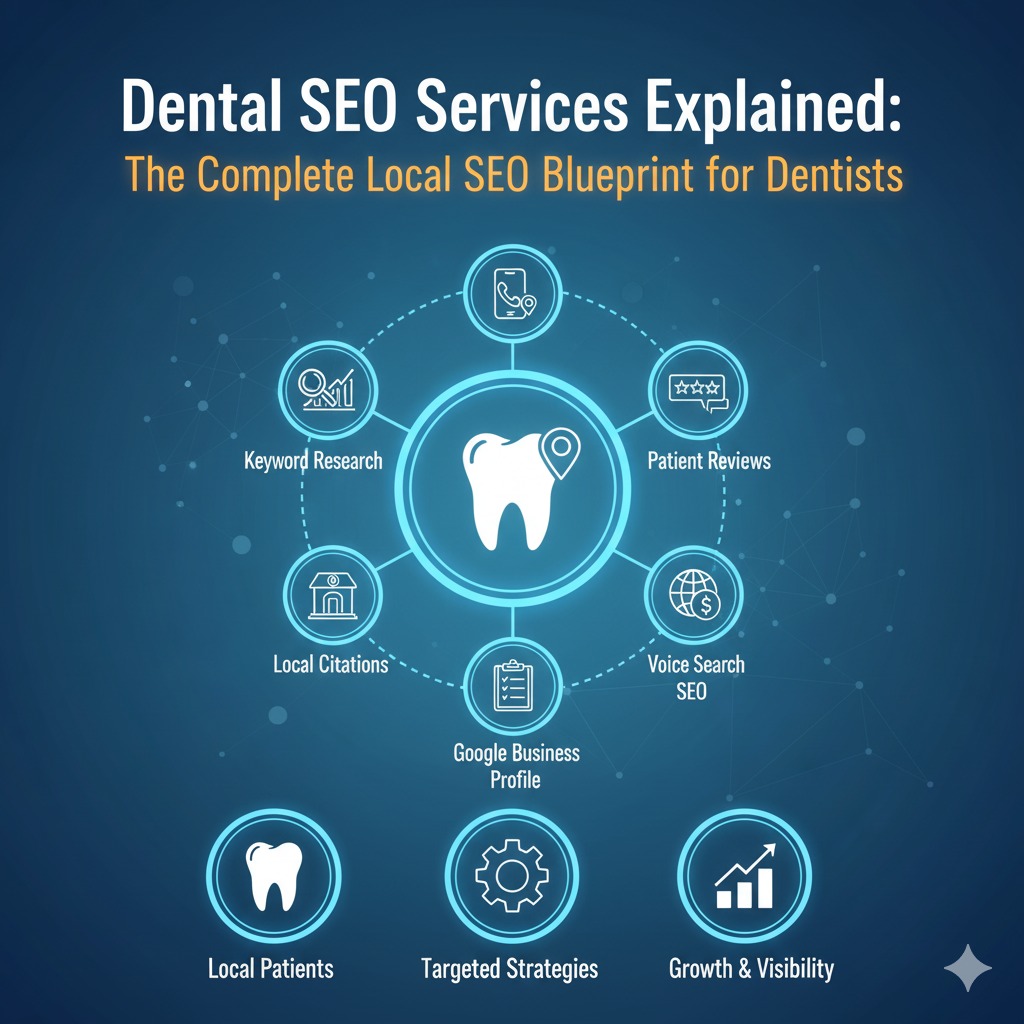
Dental SEO Services are designed to assist dental practices improve their on-line visibility and appeal to more neighborhood sufferers through organic seek. By concentrated on excessive-cause key phrases like “dentist near me” or “emergency dental health center,” dental search engine optimization techniques make certain your practice indicates up at the top of Google outcomes when capacity patients are searching for offerings. These services encompass on-web page optimization, local SEO, Google Business Profile management, technical search engine optimization, and great content material creation—making it easier on your health center to stand out in a competitive marketplace and force regular appointment bookings.

What Are Dental SEO Services?
Dental SEO services are search engine optimization techniques specifically designed with a dentist’s practice in mind. Dental SEO services aim to elevate rankings in search engines like Google, particularly maps during local searches like “dentist near me” or “emergency dentist [city],” ultimately increasing organic traffic, better online visibility, and more new patients with focused digital marketing.
Dental SEO involves several optimization techniques including keyword optimization, content development, google business profile (GBP) optimization, local citations, and on-page SEO tailored to dental website practices.
Why is Dental SEO Important in the Digital Marketing Landscape?
In today’s digital marketing landscape, having a strong online presence is essential for growth. Over 75% of patients look at a dentist’s practice in some capacity online before they make an appointment. So without the right SEO practices in place, even a highly qualified dentist can be pushed down the rankings by other practices that dominate the search results.
Dental marketing SEO gives you the opportunity to appear on the first page of Google when relevant keywords are being searched, allowing potential patients to conveniently find and trust your service, then all of your marketing initiatives will work together cohesively. Dental SEO services also consolidate your content marketing, social proof through reviews, and web design that is mobile-friendly, impacts your SEO rankings.

Why Dentists Need SEO?
Online Visibility in Local Markets
Most dental patients search for services locally — often within a 5–10 mile radius. That’s where local SEO for dentists becomes crucial. By optimizing your practice for local search intent, such as using geo-specific keywords (“pediatric dentist in Chicago”), you ensure that your dental clinic appears in Google Maps, local packs, and organic search results.
Techniques like NAP consistency (Name, Address, Phone), local citations, and optimized Google Business Profiles play a key role in driving local visibility.
High Competition in the Dental Industry
The dental field is highly competitive, especially in urban areas. Dozens of practices may be targeting the same patients. Without a tailored dental SEO strategy, it’s nearly impossible to outrank competitors organically.
SEO gives smaller or newer practices a level playing field. By investing in content-rich pages, location-targeted service pages, and review management, dentists can climb the search rankings and attract more appointments—even with a limited ad budget.
Patient Search Behavior (“dentist near me”)
Modern patients turn to Google for everything—from finding the best cosmetic dentist near me to checking dental office reviews. Search queries like:
- “Affordable dentist near me”
- “Emergency dental care open now”
- “Teeth whitening services in [city]”
are extremely common. These are high-intent local search phrases. If your website and content are not optimized for these terms, you’ll be missing valuable traffic to your dental website. Semantic SEO for dentists allows your content to reflect patient search behavior and intent so you can increase visibility and conversion rates.
Understanding the Importance of SEO for Dentists
In a world that is heavily dominated by digital-first experiences, your dental practice only exists online and most importantly, to potential patients, it exists when they are searching. SEO for dentists is crucial in helping potential patients find you. Search engine optimization is no longer optional. SEO is a must-have for any dentist that wants to establish growth, competitiveness, and an influx of new patients for their dental practice.
How Patients Search for Dentists Online
Modern patients don’t flip through phone books—they turn to Google. Whether someone needs an emergency root canal or is looking for cosmetic teeth whitening, the journey begins with a search like:
- “dentist near me”
- “emergency dental care [city]”
- “affordable family dentist”
Google Search Trends
Data shows that terms such as “dentist near me” and “best dentist in [location]” have consistently high search volume. In fact, over 80% of consumers use search engines to find local services, and dental care is no exception. These searches often carry high purchase intent, meaning patients are actively looking to book an appointment soon.
Local Map Packs
One of the most important aspects of local SEO is a Google Map Pack, which is the three dental practices that appear at the top of the search results with their map location, reviews, and phone number. Getting into this section greatly improves visibility and substantially increases calling and clicking through to your website. If your dental practice is highly competitive in your proximity to patients seeking local dental services, then your practice must have an optimized Google Business Profile (GBP), and also needs to have an accurate “NAP” (Name, Address, Phone) and local citations, and will need consistent reviews.

Benefits of SEO for Dental Clinics
More Qualified Website Traffic
Unlike paid ads that disappear when your budget runs out, SEO drives long-term traffic to your site. And not just any traffic—qualified traffic. These are people actively trying to find dental offerings, whether it’s a routine cleansing or emergency tooth extraction. With the right key-word targeting and content material method, SEO connects you with sufferers who are ready to act.
Increased Patient Appointments
By improving your visibility on Google, search engine marketing evidently leads to more appointment bookings. When patients locate your website effortlessly, see advantageous reviews, and land on a fast, user-pleasant internet site, they’re a long way more likely to transform. Local search engine optimization ensures your hospital appears prominently when someone searches in your place, assisting flip on line hobby into real-global visits.
Better Online Reputation and Reviews
SEO and online reputation management go hand in hand. Google favors businesses with strong, consistent reviews. Encouraging satisfied patients to leave 5-star reviews on your Google profile not only enhances trust but also boosts your ranking. SEO strategies often include review generation and reputation monitoring, helping you build credibility and attract even more patients over time.

3. Core Components of Dental SEO Services
To stand out in a competitive dental market, your practice needs more than a simple website—it needs a comprehensive dental SEO strategy. From keyword research to technical SEO, every element plays a role in boosting your online visibility, increasing website traffic, and driving new patient appointments.
3.1 Keyword Research for Dentists
Keyword research forms the foundation of any successful dentist SEO strategy. Knowing what your potential patients are searching for—and how to rank for it—can be the difference between a high-converting website and one that gets buried in the search results.
Local Keywords vs National Terms
For most dental clinics, local keywords are more valuable than national ones. Terms like “emergency dentist in [city]” or “family dental care near me” are highly targeted and relevant to your local patient base. National terms like “how to whiten teeth” might generate traffic but not always qualified leads.
Focusing on geo-targeted keywords helps you attract users who are actively searching for services in your immediate area—people who are ready to book an appointment.
Service-Based Keywords
Your website should target specific dental services offered at your clinic. These include keywords like:
- “teeth whitening in [city]”
- “Invisalign specialist [location]”
- “pediatric dentist near me”
These high-intent service-based keywords help attract users looking for a specific treatment or specialty.
Long-Tail Keywords for Specialties
Long-tail keywords—phrases that are more specific and less competitive—are excellent for targeting niche services. For example:
- “sedation dentistry for anxiety patients in [city]”
- “laser gum treatment near [location]”
These keywords drive more qualified traffic and can be easier to rank for than broad terms.
3.2 On-Page Optimization
Once the right keywords are identified, it’s time to implement them through on-page SEO for dentists.
Title Tags and Meta Descriptions
Each page should have a unique title tag and meta description that includes your target keyword and reflects the intent of the page. These are what users see in search engine results and influence whether they click through.
Header Structure (H1, H2)
Proper use of headers (H1, H2, H3) helps both users and search engines understand the content. Use one H1 per page (usually the page title), with clear subheadings (H2, H3) to break up the content and improve readability.
Schema Markup for Dentists
Schema markup is a form of structured data that helps Google understand your content. Using dental-specific schema, such as MedicalClinic, Dentist, and LocalBusiness, can enhance your visibility through rich results like star ratings, FAQs, or services.
Internal Linking Strategies
Smart internal linking improves crawlability and user experience. Link between service pages, blog posts, and your contact page using keyword-rich anchor text. For example: Learn more about our cosmetic dentistry services.
3.3 Google Business Profile Optimization
Importance of GBP for Local SEO
Your Google Business Profile (GBP) is critical for local SEO and Google Map Pack rankings. It’s often the first impression a potential patient will have of your clinic.
How to Optimize GBP for Dental Practices
- Use your exact business name, address, and phone number (NAP)
- Select appropriate business categories (e.g., Dentist, Cosmetic Dentist)
- Add high-quality images of your clinic and staff
- Write a keyword-rich business description
- Keep hours of operation updated
Managing Reviews and Ratings
Encourage satisfied patients to leave Google reviews. Respond to all reviews—positive or negative—to build trust and engagement. Reviews are a ranking factor in local SEO and directly influence your online reputation.
3.4 Technical SEO
3.4 Technical SEO
A site with technical issues will not rank, no matter how solid the content is. As part of an overall dental SEO audit, make sure you check the following:
Site Speed and Mobile Optimization
Users will leave your site if it does not load quickly or is not optimized for mobile. You need fast-loading pages and responsive design to rank and offer the user experience you were aiming for.
Secure Website (HTTPS)
The website should have an SSL certificate (HTTPS). This makes your website secure, and Google considers this a ranking signal as well. While website security is important for many reasons, users will feel more comfortable knowing their information is secure.
Structured Data and Schema Specific to Dental
Using structured data (as noted above) gives Google more information about your practice. Using schema specific to dental will help improve your chance of appearing in rich results and local packs.

4. Local SEO for Dental Clinics
What Is Local SEO?
Local SEO is a digital marketing strategy focused on optimizing your dental practice to appear in local search results. When a patient types “best dentist near me” or “emergency dentist in [city]”, local SEO ensures your clinic shows up in Google’s Local Pack, Maps, and organic listings.
NAP Consistency
NAP stands for Name, Address, and Phone number. Consistency across all platforms—your website, Google Business Profile, Yelp, dental directories, etc.—is essential. Mismatched NAP details confuse search engines and can hurt your local rankings.
Citations on Dental Directories
Listing your practice on reputable dental directories like Healthgrades, Zocdoc, and 1-800-Dentist builds local trust and enhances visibility. These citations act as backlinks and send strong location signals to search engines.
Localized Content Creation
Create location-specific content for each service and target area. For example:
- “Teeth whitening in Manchester”
- “Family dental care in downtown Chicago”
Localized blog posts, FAQs, and service pages help capture geo-targeted traffic and improve engagement with your local audience.
Google Map Pack Rankings
Ranking in the Google Map Pack requires a combination of on-page SEO, a fully optimized GBP, local citations, and positive reviews. Since Map Pack listings appear above organic results, this prime placement greatly increases visibility and calls to your clinic.

5. Content Marketing for Dentists
In a competitive dental landscape, simply having a website isn’t enough. You need a strategy that builds trust, educates your audience, and improves your visibility in search engines. That’s where content marketing for dentists comes in. A well-planned dental content strategy can significantly enhance your SEO, establish your authority, and convert casual visitors into loyal patients.
Blogging Strategies
Blogging is a powerful component of dental blog SEO. Google rewards websites that consistently publish fresh, helpful, and original content. A dental blog helps you target long-tail keywords, address patient concerns, and position your clinic as a go-to expert in oral health.
FAQ-Based Content
Creating blog posts around frequently asked questions not only helps your SEO but also directly addresses patient concerns. Topics like:
- “How often should I visit the dentist?”
- “Is teeth whitening safe?”
- “What should I do in a dental emergency?”
This format obviously contains semantic seek terms and voice-seek queries, assisting you rank in featured snippets and “People Also Ask” sections on Google.
Common Dental Procedures Explained
Patients want to apprehend what they’re signing up for. Writing clear, informative blog posts about treatments like root canals, Invisalign, or dental implants builds confidence and drives traffic. Use neighborhood key phrases like “What to expect at some stage in a root canal in [city]” to draw local site visitors.
These procedure-primarily based posts are perfect possibilities for inner linking to applicable carrier pages, strengthening your typical website online shape.
Educational Videos and Infographics
Not everyone prefers reading. Many patients engage better with visual content like videos and infographics. Short explainer videos that cover topics like “How to brush properly” or “What is gum disease?” help educate patients while improving dwell time on your site—a positive SEO signal.
Infographics summarizing complex procedures or post-operative care can be shared on social media and embedded in blogs, supporting both user experience and backlink opportunities.
Patient Testimonials and Case Studies
Patient stories are incredibly powerful trust signals. Incorporate testimonials, before-and-after photos, or even video interviews with real patients. You can turn these into:
- Case study blog posts
- Homepage testimonial sections
- Video snippets for social proof
These elements not only humanize your brand but also contribute to local SEO relevance by mentioning procedures, locations, and keywords naturally.
6. Link Building for Dentists
In the world of dental SEO, backlinks are like digital referrals. The more reputable websites that link to your dental site, the more trustworthy and authoritative your practice appears to search engines like Google. This process is known as link building, and it’s a key factor in boosting your rankings, especially for competitive local keywords like “best dentist in [city]” or “cosmetic dentistry near me.”
What Is Link Building in Dental SEO?
Link building for dentists involves acquiring quality, relevant links from external websites that point to your dental practice website. These links act as endorsements, signaling to search engines that your site provides valuable information worth referencing. However, not all backlinks are created equal—white hat SEO techniques should always be used to avoid penalties and ensure long-term growth.
White Hat Link Building Techniques
Ethical, white hat link building focuses on earning links naturally through value-driven outreach and relationships, rather than manipulative tactics.
Guest Posts on Health Blogs
Writing informative guest posts for reputable health, wellness, or dental blogs is an excellent way to earn contextual backlinks. Topics like “Top 5 Dental Habits for a Healthier Smile” or “What Parents Should Know About Pediatric Dentistry” can position you as a subject-matter expert and direct referral traffic to your website.
Local Sponsorships (Schools, Community Events)
Supporting local schools, charities, or community events often earns you a link from their websites. These local sponsorships not only build backlinks but also enhance your presence within the community—boosting both SEO and brand trust.
Dental Directory Listings
Getting listed on reputable dental directories such as Zocdoc, Healthgrades, CareDash, and 1-800-Dentist offers valuable citations and SEO backlinks. Ensure your NAP (Name, Address, Phone) is consistent across all listings to strengthen your local SEO profile.
PR Outreach for Dental Clinics
Public relations (PR) efforts like sharing your clinic’s milestones, charity work, or expert advice with local media can earn high-authority links from news outlets. A well-placed story on a local news site or dental journal adds credibility and powerful backlinks to your SEO strategy.
7. Technical SEO for Dental Websites
While content and keywords often get the spotlight in SEO strategies, the technical health of your dental website is just as important. Technical SEO for dentists ensures that your site is fast, mobile-friendly, easy to navigate, and error-free—giving both users and search engines a smooth experience. A strong technical foundation supports higher rankings, better crawlability, and more conversions.
Site Architecture for Dental Practices
Your site architecture determines how easily search engines and users can navigate your website. A well-structured dental website should follow a logical hierarchy:
- Homepage
- Services
- Teeth Whitening
- Dental Implants
- Invisalign
- About Us
- Contact
- Blog
- Services
Clear navigation menus, breadcrumb trails, and internal links improve user experience and help Google index your pages effectively. Don’t bury important service pages too deep—keep them within 2–3 clicks from the homepage.
Mobile Responsiveness
More than 60% of dental searches now happen on smartphones. If your site isn’t optimized for mobile devices, you’re not just losing patients—you’re also losing rankings. Mobile SEO for dental practices means your site should:
- Resize gracefully across screens
- Use legible fonts and clickable buttons
- Avoid horizontal scrolling
- Load quickly on mobile connections
Google uses mobile-first indexing, so mobile responsiveness is now a direct ranking factor.
Fast Loading Times
Site speed is critical for user retention and SEO. If your dental site takes more than 2–3 seconds to load, visitors may leave before seeing your services. Compress images, minimize scripts, and use fast hosting to improve dental website speed. Tools like Google PageSpeed Insights or GTmetrix can help identify and fix bottlenecks.
Fixing Crawl Errors and Broken Links
Search engines need to crawl and index your website efficiently. Crawl errors, broken internal links, or 404 pages can prevent your important content from being seen. Regularly perform a technical SEO audit using tools like Screaming Frog or Google Search Console to:
- Identify crawl issues
- Fix broken links
- Submit updated sitemaps
- Ensure all pages are indexed properly
In summary, technical SEO ensures that your beautifully written content and services actually reach the audience you’re targeting. When your site is technically sound, search engines reward you with better visibility—and patients reward you with trust.
8. SEO for Multi-Location Dental Practices
If your dental brand operates in multiple cities or neighborhoods, your SEO strategy needs to be localized for each branch. Implementing multi-location dental SEO ensures that each clinic ranks independently in its local area, increasing your visibility and patient reach across all regions.
Separate Pages for Each Location
One of the biggest mistakes multi-location practices make is directing all traffic to a single contact page. Instead, create dedicated landing pages for each office location. For example:
- /dentist-new-york
- /dental-clinic-los-angeles
- /family-dentist-chicago
Each of these location-specific pages should be optimized with the correct name, address, phone number (NAP), business hours, and services offered at that branch.
Unique Content per Location
Avoid copy-pasting the same text across all location pages. Instead, write unique, localized content for each branch. Highlight:
- Local landmarks or neighborhoods near your office
- Staff members working at that location
- Specific services or specialties offered in that area
- Community involvement or local events
This not only boosts SEO but also increases local relevance and trust with your audience.
Location-Based Schema Markup
Implement location-based schema markup (e.g., LocalBusiness, Dentist) for each clinic. Structured data helps Google understand the geographical relevance of each branch and can increase your chances of appearing in local search features like the Google Map Pack or knowledge panels.
Include key details in the markup:
- Business name
- Address and phone number
- Hours of operation
- Geo-coordinates
- SameAs (links to social media profiles)
Local Link Building per Branch
Each dental office should have its own local backlink profile. Engage in local link building by:
- Sponsoring neighborhood events
- Joining local chambers of commerce
- Submitting to city-specific business directories
- Earning links from local news or blogs
This strengthens the authority of each location page and boosts its ability to rank in local search results.
Conclusion: A successful multi-location SEO strategy treats each dental office as a unique entity—because to search engines and patients, it is. With custom content, local schema, and tailored backlinks, your practice can dominate multiple local markets simultaneously.
9. Measuring Success: SEO KPIs for Dentists
Effective SEO isn’t a one-time fix—it’s an ongoing strategy that requires consistent tracking and analysis. To ensure your dental SEO campaign is driving results, you need to monitor the right SEO KPIs (Key Performance Indicators). With tools like Google Analytics 4 (GA4), Google Search Console (GSC), and Google Business Profile (GBP) insights, you can measure what’s working and where to improve.
Tracking Tools (GA4, GSC, etc.)
Start with reliable tools that offer in-depth tracking:
- Google Analytics 4 (GA4): Understand how users find and interact with your site, track conversion events like phone clicks and form submissions.
- Google Search Console (GSC): Monitor keyword rankings, crawl errors, indexing status, and page performance in Google Search.
- Google Business Profile Insights: Track local searches, map views, direction requests, and call actions directly from your GBP listing.
You may also consider tools like SEMrush, Ahrefs, or BrightLocal for advanced tracking and competitive analysis.
Key SEO Metrics to Monitor
To determine the effectiveness of your dental SEO strategy, focus on the metrics that matter most:
Keyword Rankings
Track how your target keywords—such as “family dentist in [city]” or “Invisalign specialist near me”—are performing. Improved rankings typically correlate with increased visibility and traffic.
Organic Traffic
Monitor growth in organic search traffic to key pages like service descriptions, blog posts, and contact forms. A steady rise indicates your content and optimization are attracting more potential patients.
Phone Calls / Form Fills
The ultimate goal of SEO is conversion. Use event tracking in GA4 to count how many users click to call or complete a booking form. These are tangible indicators of ROI.
GMB Insights
Review data from your Google Business Profile regularly, including:
- Number of times your listing was shown
- How many users clicked “Call,” “Visit Website,” or “Get Directions”
- Search terms used to find your listing
Monthly SEO Reports for Dentists
Create or request detailed monthly SEO reports summarizing all performance data. These reports should highlight:
- Wins (e.g., keyword movements, traffic growth)
- Areas for improvement (e.g., low-converting pages)
- Recommendations for ongoing strategy
SEO reporting helps dentists understand progress and make informed decisions based on real data—not guesswork.
Conclusion: By tracking the right KPIs and using tools like GA4 and GSC, your practice can measure SEO success, adjust strategy, and continue to attract more local patients.

10. Common Dental SEO Mistakes to Avoid
Optimized for keywords: dental SEO errors, dentist SEO problems, common dental SEO issues
Even the best dental websites can fall short if they make key SEO mistakes. Avoiding these common dental SEO issues is essential for maintaining high rankings and attracting new patients.
Keyword Stuffing
Overusing keywords like “dentist in [city]” throughout your content makes it unreadable and unnatural. Keyword stuffing is penalized by Google and turns visitors away. Focus on semantic keywords and user intent instead.
Ignoring Mobile Users
A large portion of dental searches comes from smartphones. If your site isn’t mobile-friendly, you risk losing both traffic and Google rankings. Ensure responsive design, fast loading, and mobile usability.
Duplicate Content Across Location Pages
Many multi-location clinics copy the same content across their location pages. This leads to duplicate content, which can hurt rankings. Create unique, localized content for each branch.
Not Updating GBP
Failing to regularly update your Google Business Profile (GBP) can result in inaccurate information, missed reviews, and lower visibility. Keep your hours, photos, and services current.
Lack of HTTPS or SSL Certificate
Running your site without an SSL certificate (HTTPS) is a major dental SEO error. It compromises trust and security—two critical factors in both patient experience and Google’s ranking algorithm.
Avoid these dentist SEO problems, and you’ll build a stronger foundation for long-term success.
11. DIY vs Hiring a Dental SEO Agency
Optimized for keywords: dental SEO expert, dentist SEO consultant, dental SEO company, SEO agency for dentists
When it comes to improving your dental practice’s online visibility, you may wonder: should you handle SEO on your own or work with a dental SEO expert? Both approaches have pros and cons, but the decision comes down to your time, resources, and goals.
Pros and Cons of Doing It Yourself
Pros:
- Budget-friendly
- Full control over strategy
- Learning opportunity
Cons:
- Steep learning curve
- Time-consuming
- Mistakes can lead to penalties or lost rankings
- Limited access to advanced tools
DIY SEO may work for tech-savvy dentists with the time to learn, but most practices benefit more from professional guidance.
Benefits of Hiring Experts
Partnering with a dental SEO company or dentist SEO consultant brings a strategic, data-driven approach to growing your practice.
Proven Case Studies & Industry Experience
A professional SEO agency for dentists will have experience with similar practices, backed by case studies and results. They understand industry trends, patient search behavior, and how to compete in local markets.
Transparent Reporting
A trustworthy dental SEO agency will provide clear, monthly reports showing keyword rankings, traffic, conversions, and ROI—ensuring you’re not left in the dark.
What to Look for in a Dental SEO Company
- Experience in the dental or healthcare industry
- Customized local SEO strategies
- Google Business Profile optimization
- Technical and content expertise
- Strong communication and reviews
Conclusion: While DIY SEO can work in some cases, most dental practices benefit from working with a professional dental SEO expert who can help deliver faster, measurable results without the guesswork.

12. Choosing the Best Dental SEO Services Provider
Optimized for keywords: best dental SEO agency, SEO services for dental practices, top dentist SEO providers
Choosing the right partner for your practice’s growth can make or break your online success. With so many agencies claiming to be the best dental SEO agency, it’s important to know what to look for—and what to avoid. A great provider will deliver real results, not empty promises.
Qualities of a Good Dental SEO Company
A trustworthy agency offering SEO services for dental practices will focus on strategy, transparency, and long-term growth.
Customized Strategy
Every dental practice is different—your SEO should reflect that. The top dentist SEO providers tailor their strategy based on your location, competition, services, and business goals. Look for an agency that performs a full dental SEO audit before proposing solutions.
Regular Communication
Consistent updates, performance reports, and strategy meetings are essential. A good agency will clearly explain what they’re doing, why it matters, and how it’s impacting your business. You should never feel left in the dark.
Local and National SEO Experience
Whether you’re a local clinic or a multi-location practice, your agency should have proven experience in both local SEO (ranking in your city) and broader SEO (ranking for educational or service-based content across regions). Ask for case studies or success stories specific to the dental industry.
Red Flags to Watch
Not all agencies play by the rules. Watch out for these signs:
Guaranteed #1 Rankings
No one can guarantee #1 positions on Google. If an agency makes this promise, it’s a major red flag. SEO takes time, testing, and ongoing effort—not shortcuts.
Black Hat Techniques
Avoid agencies using shady tactics like keyword stuffing, spammy backlinks, or fake reviews. These black hat techniques may offer short-term results but can lead to long-term penalties and a damaged online reputation.
Conclusion: The right dental SEO partner is transparent, experienced, and focused on your clinic’s unique needs. Take time to research, ask questions, and choose an agency that aligns with your long-term vision—not just short-term hype.
13. Case Studies or Testimonials (Optional Section – 300–500 words)
Real Dental SEO Success Stories
Choosing an SEO provider is easier when you can see real-world results. These success stories and dental SEO reviews show how strategic SEO can help transform dental practices by increasing visibility, attracting new patients, and improving online reputations.
📈 Case Study #1: Family Smile Dental – Austin, TX
Problem:
Family Smile Dental struggled to appear on the first page of Google for even basic keywords like “family dentist in Austin”. Their traffic was flat, and appointment requests through the website were rare.
Solution:
A custom local SEO strategy was implemented, including optimized service pages, Google Business Profile enhancements, and a targeted blog content plan using long-tail keywords like “pediatric dental care in Austin”.
Results (After 6 Months):
- Organic traffic increased by 135%
- Top 3 rankings for 15+ local keywords
- 3x increase in appointment requests via website
- Featured in Google’s Local Map Pack
💬 Client Testimonial – Dr. Sarah Mitchell, Houston
“Our online presence was nearly invisible before working with this team. Within months, we were ranking for competitive terms like ‘Invisalign specialist Houston’. Their transparency and monthly reporting gave us confidence we were investing in real results.”
— Dr. Sarah Mitchell, Bright Dental Group
🦷 Case Study #2: ClearView Orthodontics – Denver, CO
Problem:
The client had a beautiful website but wasn’t getting traffic or conversions. They were also missing structured data and had no backlink profile.
Solution:
We conducted a full SEO audit, implemented structured schema markup for dental services, launched a local content campaign, and earned backlinks from dental associations and health blogs.
Results (After 9 Months):
- 1st page ranking for “braces for adults Denver”
- 200% increase in organic leads
- Bounce rate dropped by 40% due to improved site speed and mobile UX
These dentist SEO results prove that with the right strategy and consistent effort, dental practices can thrive online—no matter their size or location.
14. FAQs About Dental SEO
Optimized for keywords: dental SEO timeline, dentist SEO pricing, SEO vs PPC for dentists
How long does dental SEO take?
SEO is a long-term strategy. Most dental practices begin to see noticeable improvements in 3 to 6 months, with significant results—like top Google rankings—typically occurring within 6 to 12 months, depending on competition and consistency.
What does dental SEO cost?
Dentist SEO pricing varies based on the size of your practice, the number of locations, and service scope. On average, monthly SEO for dental clinics ranges from $500 to $2,500+. Always look for transparent pricing and customized packages.
Do I need SEO if I use Google Ads?
Yes. While Google Ads drive immediate traffic, SEO builds long-term, sustainable visibility. Ideally, your practice should use SEO and PPC together to cover both short- and long-term patient acquisition strategies.
Is SEO better than social media for dentists?
Both have value, but SEO targets high-intent patients—people actively searching for a dentist. Social media builds brand awareness and trust, but SEO typically offers higher ROI for appointment-based conversions.