


Local SEO services help businesses improve their visibility in location-based search results, attract nearby customers and generate more enquiries, calls, bookings and visits. Whether you operate a restaurant, law firm, dental clinic, construction company or retail shop, appearing when people search for services in your area can make a significant difference to business growth.
For example, someone searching for “SEO agency near me” or “best dentist in Karachi” is usually looking for a nearby business they can contact. Local search optimisation helps businesses become more visible for these searches through Google Maps, local search results and relevant website pages.
However, local SEO involves more than adding a city name to a website. A professional strategy combines Google Business Profile optimisation, local keyword research, website improvements, business listings, reputation management and ongoing performance tracking.
In this guide, we’ll explain what local SEO services include, how the process works, what results businesses can expect and how to choose the right provider.
What Are Local SEO Services?
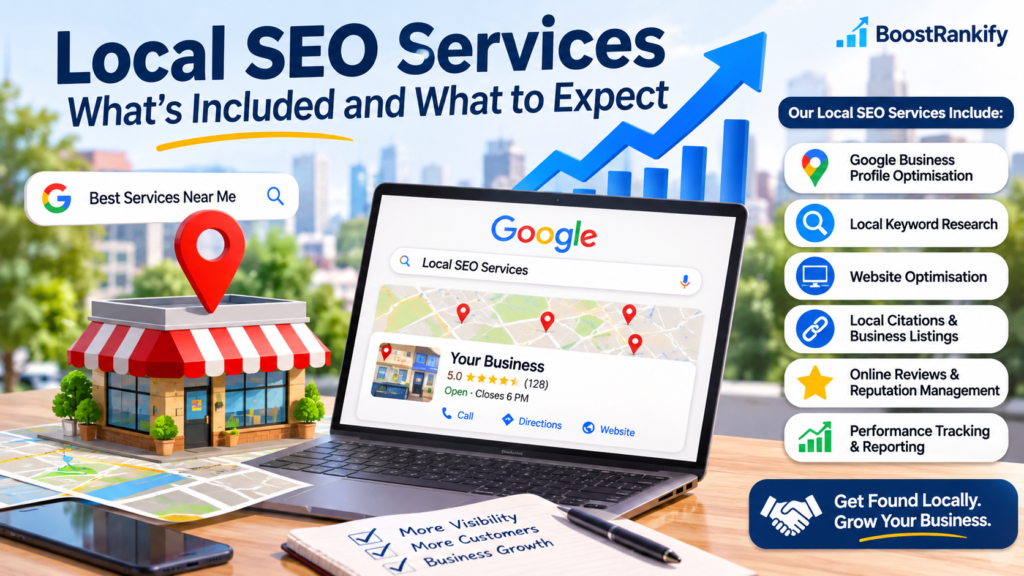
Local SEO services are specialised search engine optimisation activities designed to improve a business’s visibility in searches connected to a particular geographical location.
Unlike traditional SEO, which may target national or international audiences, local SEO focuses on reaching potential customers in specific cities, neighbourhoods or service areas.
For example, a business operating in Karachi may want to appear for searches such as:
- SEO services in Karachi.
- Best marketing agency in Clifton.
- Digital marketing company near me.
- Local SEO agency in Gulshan-e-Iqbal.
A local SEO strategy helps search engines understand what your business offers, where it operates and which customers its services are relevant to.
Google generally considers three main factors when determining local search visibility:
- Relevance: How closely a business matches someone’s search.
- Distance: How far the business is from the searcher’s location or specified area.
- Prominence: How well-known and established the business appears to be.
These factors influence local visibility, although businesses cannot guarantee a particular position through optimisation alone.
If you’re looking for professional support, explore BoostRankify’s SEO services to understand how broader SEO strategies can support business growth.
What Do Local SEO Services Include?
Professional local SEO services usually cover several connected activities. The exact deliverables depend on your business type, competition, target locations and existing online presence.
1. Google Business Profile Optimisation
Google Business Profile optimisation is one of the most important parts of local SEO.
A properly managed profile helps eligible businesses appear in Google Maps and local search results. It also gives potential customers useful information before they visit or contact a business.
This service commonly includes:
- Setting up or improving the Google Business Profile.
- Selecting accurate primary and secondary categories.
- Adding business hours, contact details and website links.
- Writing a clear business description.
- Uploading relevant, genuine photographs.
- Adding eligible products and services.
- Publishing useful business updates.
- Monitoring profile information and performance.
Businesses should also maintain accurate opening hours and update their profiles when important information changes.
2. Local Keyword Research
Local keyword research identifies the phrases potential customers use when searching for products or services in a particular area.
For example, a roofing company may target:
- Roofing services in London.
- Emergency roof repair near me.
- Professional roofers in East London.
- Affordable roof replacement in London.
A professional local SEO strategy identifies relevant search terms based on location, search intent, competition and business offerings.
Keyword research may also include neighbourhood-specific phrases, conversational searches and question-based queries.
The goal is not to repeat location keywords unnecessarily. Instead, businesses should create useful content that answers genuine customer needs.
3. Local Website Optimisation
Your website needs to communicate clearly what your business offers and which geographical areas it serves.
Local website optimisation can include:
- Improving title tags and meta descriptions.
- Optimising headings and page content.
- Adding relevant location information.
- Improving website speed and mobile usability.
- Optimising images and internal links.
- Creating location-specific landing pages.
- Adding appropriate LocalBusiness structured data.
For businesses targeting multiple areas, individual location pages can help explain the services available in each location.
However, these pages should provide genuinely useful, locally relevant information rather than repeating identical content with different city names.
Businesses targeting several UK locations can explore BoostRankify’s SEO services in the UK for additional location-focused support.
4. Local Citations and Business Listings
Local citations are online mentions of a business’s name, address and phone number, commonly known as NAP information.
These details can appear in business directories, industry websites, local platforms and relevant business listings.
Local SEO services may include:
- Identifying relevant business directories.
- Creating or updating business listings.
- Correcting inconsistent contact information.
- Removing duplicate listings where possible.
- Maintaining consistent business details.
- Finding industry-specific citation opportunities.
Accurate information helps customers contact businesses and reduces confusion caused by outdated or inconsistent listings.
For additional listing opportunities, see our guide to free business listing sites.
5. Online Reviews and Reputation Management
Online reviews influence how potential customers evaluate local businesses.
A strong review profile can help establish trust, provide useful customer feedback and improve the likelihood that someone chooses your business.
Reputation management services may involve:
- Monitoring reviews across relevant platforms.
- Encouraging genuine customer feedback.
- Responding professionally to positive reviews.
- Addressing negative feedback constructively.
- Identifying recurring customer concerns.
- Monitoring overall review trends.
Businesses should never purchase fake reviews or offer prohibited incentives in exchange for positive ratings.
Authentic feedback and professional responses are more sustainable ways to develop a trustworthy online reputation.
6. Local Link Building
Local link building involves earning relevant backlinks from websites connected to your industry, community or geographical area.
Potential opportunities include:
- Local business associations.
- Community organisations.
- Industry publications.
- Local news websites.
- Relevant professional directories.
- Genuine partnerships and sponsorships.
Quality and relevance matter more than simply collecting a large number of backlinks.
Some businesses may also benefit from carefully selected guest posting opportunities. You can explore BoostRankify’s guest post services to learn more about this approach.
7. Location-Specific Content Creation
Content marketing supports local SEO by answering questions that matter to customers in specific locations.
Examples include:
- Local service guides.
- Neighbourhood-specific business information.
- Frequently asked questions.
- Local industry insights.
- Service comparison articles.
- Location-based case studies.
For example, a construction company could publish an article explaining common roofing problems in its service area.
A healthcare provider could create informative pages explaining available treatments and appointment processes.
The purpose is to provide useful information while naturally connecting relevant services with local search intent.
8. Technical SEO and Local Schema Markup
Technical SEO helps search engines discover, crawl and understand your website.
Local SEO providers may review:
- Website indexing and crawlability.
- XML sitemaps.
- Broken links and redirects.
- Mobile responsiveness.
- Page loading performance.
- Canonical URLs.
- Structured data implementation.
LocalBusiness schema can communicate information about an eligible business, such as its name, address, contact details and opening hours.
Structured data does not guarantee rich results or higher rankings, but it can help search engines interpret business information.
9. Local SEO Reporting and Performance Tracking
Professional local SEO services should include regular performance monitoring.
A typical report may cover:
- Organic search traffic.
- Local keyword visibility.
- Google Business Profile interactions.
- Website enquiries and phone calls.
- Conversion rates.
- Backlink growth.
- Technical SEO issues.
- Completed optimisation activities.
Reporting should explain what has been completed, what has improved and which activities need further attention.
A good provider measures business outcomes rather than focusing exclusively on keyword rankings.
How Does the Local SEO Process Work?
A structured local SEO campaign generally follows these stages:
- Initial SEO audit: Review the website, business listings, competitors and current search visibility.
- Keyword research: Identify relevant local search terms and customer search intent.
- Business profile optimisation: Improve the accuracy and completeness of the Google Business Profile.
- Website improvements: Optimise existing pages and develop relevant location-specific content.
- Citation management: Build and correct relevant business listings.
- Reputation development: Establish a consistent approach to genuine customer reviews.
- Authority building: Develop relevant backlinks and local relationships.
- Performance monitoring: Review results and adjust the strategy based on data.
The process should be adapted to the business rather than following an identical checklist for every client.
How Much Do Local SEO Services Cost?
The cost of local SEO services depends on the size of the business, the competitiveness of its industry, the number of target locations and the amount of work required.
A small business targeting one neighbourhood may need a relatively focused campaign. A company operating across several cities may require more extensive website optimisation, location pages, citation management and link-building activities.
Common pricing models include:
| Pricing model | What to expect |
|---|---|
| Monthly retainer | Ongoing optimisation, reporting and support |
| One-time project | SEO audit, profile setup or website improvements |
| Hourly consulting | Specialist advice and individual SEO tasks |
| Custom campaign | A strategy designed around multiple locations or business requirements |
Before choosing a provider, request a clear breakdown of deliverables, reporting frequency, campaign duration and additional costs.
Avoid agencies promising guaranteed first-page rankings or immediate results.
How Long Does Local SEO Take to Show Results?
Local SEO is a long-term process, and results depend on your starting position, competition, business reputation and optimisation quality.
Some improvements, such as correcting inaccurate business information, may have an impact relatively quickly. More competitive ranking improvements and sustainable organic growth generally require consistent work over several months.
Businesses should monitor progress through:
- Changes in local search visibility.
- Google Maps and organic search performance.
- Relevant website traffic.
- Customer enquiries and calls.
- Qualified leads and conversions.
Rather than expecting overnight rankings, focus on measurable improvements in visibility and customer acquisition.
How to Choose the Right Local SEO Agency
Selecting the right agency can make a significant difference to your campaign.
Consider these factors before making a decision:
1. Relevant experience: Look for experience working with businesses in your industry and target locations.
2. Transparent deliverables: Ask exactly what the local SEO package includes and what activities will be performed each month.
3. Reporting quality: Choose a provider that explains results using meaningful performance metrics.
4. Ethical SEO practices: Avoid agencies using fake reviews, spammy backlinks or misleading ranking guarantees.
5. Location expertise: Make sure the agency understands your target market and local competition.
6. Communication: A reliable SEO partner should explain its strategy and provide regular updates.
You can learn more about BoostRankify and its services or contact the team to discuss your business requirements.
Are Local SEO Services Suitable for Every Business?
Local SEO is particularly valuable for businesses that serve customers in specific geographical areas.
Examples include:
- Restaurants and cafés.
- Dentists and healthcare practices.
- Lawyers and financial advisers.
- Roofing and construction companies.
- Gyms and fitness centres.
- Real estate agencies.
- Automotive repair businesses.
- Hotels and hospitality providers.
Even service-area businesses without a customer-facing shop may benefit from local SEO if they serve customers in defined locations and meet Google’s eligibility requirements.
For industry-specific strategies, explore SEO for restaurants, SEO for doctors and SEO for roofing companies.
Frequently Asked Questions About Local SEO Services
1. What is included in local SEO services?
Local SEO services commonly include Google Business Profile optimisation, local keyword research, website SEO, citation management, review monitoring, local link building, location-specific content and performance reporting.
2. Are local SEO services worth it for small businesses?
Yes. Local SEO can help small businesses reach customers searching for relevant products and services nearby. It can improve online visibility, attract qualified enquiries and support long-term business growth.
3. How much do local SEO services cost?
Pricing varies according to business size, competition, target locations and campaign requirements. Providers may charge monthly retainers, project fees, hourly rates or customised campaign prices.
4. How long does local SEO take to work?
Some improvements may become noticeable relatively quickly, but meaningful and sustainable results often require several months of consistent optimisation. Competition and the condition of your existing online presence also influence progress.
5. Do local SEO services include Google Business Profile optimisation?
Most comprehensive local SEO packages include Google Business Profile optimisation. This can involve improving business information, categories, services, photographs, updates and review management.
6. Can local SEO help businesses rank on Google Maps?
Yes. Local SEO can improve a business’s eligibility and visibility in Google Maps results through accurate business information, relevant optimisation and a strong online presence. However, no agency can guarantee a specific Maps position.
7. What is the difference between local SEO and traditional SEO?
Traditional SEO generally targets broader search audiences, while local SEO focuses on searches connected to particular geographical areas. Local SEO places additional emphasis on Google Business Profile, local citations, customer reviews and location-specific relevance.
8. Should I hire a local SEO agency or do SEO myself?
You can manage basic activities yourself, including maintaining business information and collecting genuine customer reviews. An experienced agency may be helpful when you need technical optimisation, competitive keyword research, link building and ongoing campaign management.
Conclusion
Local SEO services help businesses become more visible to potential customers searching for products and services in their area. From Google Business Profile optimisation and local citations to website improvements, reputation management and location-specific content, every activity contributes to a stronger local search presence.
The right strategy depends on your business goals, target locations and competitive environment. Rather than focusing only on rankings, businesses should prioritise accurate information, useful content, customer trust and measurable conversions.