


AI SEO tools are changing how businesses research keywords, optimise website content, analyse competitors, and improve search visibility. From automated content briefs to search intent analysis and AI-powered recommendations, these tools help marketers complete SEO tasks faster and make more informed decisions.
However, AI SEO tools are not a replacement for SEO expertise, human judgement, or a well-planned strategy. They can produce inaccurate insights, miss important context, and sometimes recommend tactics that fail to deliver sustainable results.
For businesses, marketers, bloggers, agencies, and website owners, understanding the strengths and weaknesses of AI SEO tools is essential before relying on them for everyday SEO work.
This guide explores what AI SEO tools do well, where they fall short, how to use them effectively, and how businesses can combine AI automation with human expertise to achieve better search performance.
1. What Are AI SEO Tools?
AI SEO tools are software platforms that use artificial intelligence, machine learning, natural language processing, and data analysis to help improve a website’s search engine optimisation.
Unlike traditional SEO software that mainly provides reports, charts, and keyword data, many modern tools can also interpret information, identify patterns, generate recommendations, and automate repetitive marketing tasks.
Depending on their features, AI SEO tools can help with:
- Keyword research and search intent analysis
- Content planning and topic clustering
- AI-assisted content writing and optimisation
- Competitor analysis
- Technical SEO audits
- Internal linking suggestions
- SERP analysis
- Content gap identification
- SEO reporting and performance analysis
- AI search visibility and content discovery
Businesses use these capabilities to reduce manual workload and improve the efficiency of their SEO campaigns.
For example, an SEO specialist can use AI to analyse a topic, identify related questions, generate a content outline, suggest headings, and review an article for missing information. Instead of starting every task from scratch, the specialist can use AI-generated insights as a starting point and refine them using experience and research.
The purpose is not simply to produce more content. It is to make SEO work more efficient, accurate, strategic, and aligned with what people are actually searching for.
2. How AI SEO Tools Work
Most AI-powered SEO platforms combine search data, algorithms, language models, and automated workflows to analyse websites and content.
Their process typically involves collecting data, identifying patterns, interpreting SEO opportunities, and providing recommendations.
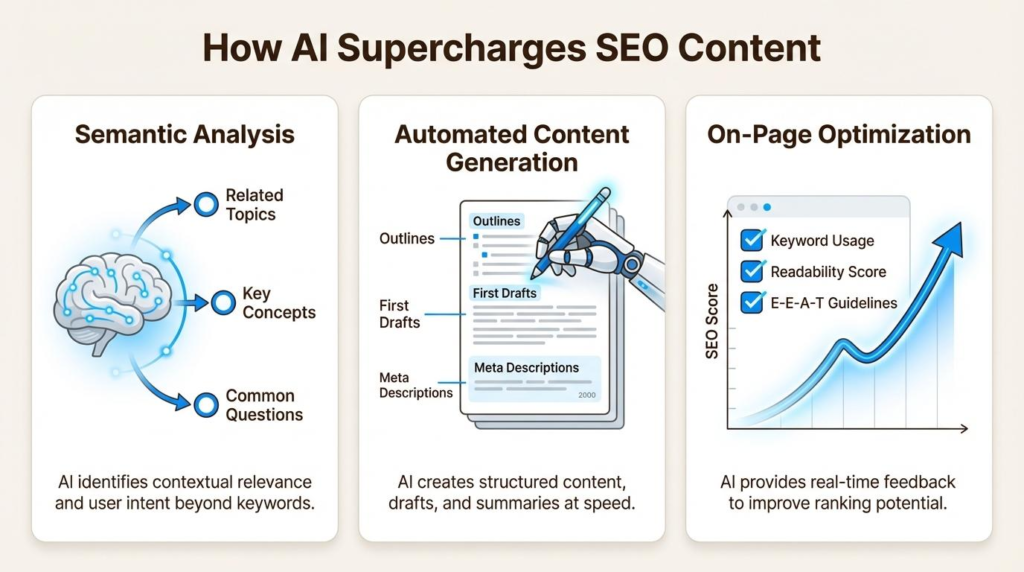
Data collection and analysis
The software gathers information from available sources, such as keyword databases, website crawls, page content, ranking reports, and competitor information.
Pattern recognition
AI systems identify relationships between keywords, topics, pages, search intent, and content structures. This can help uncover opportunities that may be difficult to spot manually.
Automated recommendations
Based on the available data, the platform may suggest new topics, missing keywords, content improvements, technical fixes, or optimisation opportunities.
Content assistance
Some platforms use generative AI to create briefs, draft paragraphs, rewrite headings, suggest metadata, or improve readability.
Performance monitoring
SEO tools can help track changes in rankings, traffic, clicks, impressions, and other available performance metrics to support ongoing optimisation.
The quality of these insights depends on the tool’s data sources, capabilities, configuration, and the expertise of the person using it.
3. What AI SEO Tools Do Well
AI provides the greatest value when it handles repetitive tasks, processes large amounts of information, and supports decisions that would otherwise take considerable time.
Faster keyword research and clustering
Keyword research is one of the strongest applications of AI in SEO. Tools can group related search terms into topics, identify keyword variations, and help marketers build content plans around broader search intent.
For example, a business offering SEO services might explore related searches such as:
- SEO services for small businesses
- Local SEO strategies
- Technical SEO audits
- SEO content optimisation
- SEO reporting tools
AI can organise these into topic clusters, making it easier to plan pages without creating unnecessary content duplication.
This can be especially useful when developing a comprehensive SEO services strategy for different industries or markets.
Improved content planning
AI can analyse topics and suggest subheadings, supporting questions, related concepts, and potential content gaps.
Content teams can use these recommendations to build more complete outlines before writing. This is particularly useful for informational blogs, product guides, service pages, and educational resources.
Rather than writing isolated articles, marketers can use AI to help build topical coverage and connect related content through a structured internal linking strategy.
Automating repetitive SEO tasks
Many SEO activities are repetitive and time-consuming. AI SEO tools can reduce the workload involved in:
- Generating meta title variations
- Creating meta descriptions
- Reviewing headings
- Categorising keywords
- Identifying missing alt text
- Summarising SEO audit reports
- Detecting potential content overlaps
- Creating reporting summaries
Automation allows SEO professionals to spend more time on strategic planning, technical decision-making, and content quality.
Supporting technical SEO analysis
Some AI-assisted platforms can interpret technical SEO reports and explain problems in simpler language. They may help prioritise issues such as broken links, duplicate titles, missing metadata, slow-loading pages, crawlability concerns, and structured data errors.
However, the recommendations should be verified before changes are made. AI can explain a technical issue, but it may not understand how a specific website’s infrastructure, plugins, or development environment works.
Competitor and content gap research
AI can help compare competing pages, identify subjects that competitors cover, and discover potential opportunities for differentiation.
It may highlight topics that appear frequently across ranking pages or suggest missing information that could make an article more useful.
This can support better content planning, but copying competitors’ structures or ideas without original value is unlikely to create a meaningful competitive advantage.
4. Where AI SEO Tools Fall Short
Despite their advantages, AI SEO tools have important limitations. Businesses that rely on automated recommendations without reviewing them can waste resources or damage the quality of their SEO strategy.

They can generate inaccurate information
AI systems can produce incorrect facts, misleading explanations, invented statistics, and outdated recommendations.
A generated article may appear professional while containing claims that are unsupported or simply wrong. This is particularly risky for technical subjects, finance, healthcare, legal information, and other areas where accuracy matters.
Every important claim, statistic, recommendation, and reference should be verified before publication.
They lack real business context
AI may understand a keyword but not the business behind it.
For example, a tool might recommend targeting a high-volume keyword that attracts visitors who are unlikely to become customers. It may not understand your profit margins, service limitations, customer expectations, location, brand positioning, or conversion goals.
Keyword traffic is not automatically valuable traffic.
Human marketers need to evaluate whether a keyword is relevant to the business and whether the content can realistically satisfy the searcher’s needs.
AI-generated content can sound generic
Many AI writing systems produce predictable introductions, repetitive explanations, similar headings, and generic conclusions.
When several websites publish content using similar prompts and information, their pages can become difficult to distinguish.
Search-focused content should offer something valuable beyond basic information, such as practical examples, first-hand experience, original analysis, expert insights, useful comparisons, and clear answers.
It cannot guarantee search rankings
No AI SEO tool can guarantee a number-one ranking on Google or other search engines.
Search visibility depends on many factors, including relevance, competition, website quality, technical performance, authority, content usefulness, and changing search algorithms.
AI can help identify opportunities, but it cannot control search engine ranking systems.
Recommendations can be misleading
An AI tool might recommend adding more keywords, rewriting headings, increasing article length, or creating additional pages.
These suggestions may not always improve performance.
If a page already answers a query effectively, unnecessary rewriting could weaken its clarity or disrupt existing ranking signals. SEO recommendations should be evaluated against actual performance data and user needs rather than followed blindly.
5. Best AI SEO Tools and What They Are Good At
Different platforms specialise in different aspects of SEO. The best choice depends on your goals, budget, workflow, and level of experience.
Semrush
Keyword research, competitor insights, site audits and content planning.
Ahrefs
Backlink research, keywords, competitor analysis and organic search data.
Surfer SEO
Content optimisation, topical coverage and on-page recommendations.
Screaming Frog SEO Spider
Technical crawls, broken links, metadata and website structure analysis.
1. Semrush
Semrush offers a broad collection of marketing and SEO features, including keyword research, competitor analysis, site audits, content research, and tracking tools.
It is useful for businesses and agencies managing multiple SEO tasks from one platform. However, the breadth of features can make it overwhelming for beginners, and its advanced plans may be costly for smaller businesses.
2. Ahrefs
Ahrefs is particularly useful for backlink analysis, keyword research, competitor discovery, and evaluating organic search opportunities.
It helps SEO professionals understand how competing websites attract organic traffic and where new content opportunities may exist. However, its data should not be treated as an exact representation of Google’s own search data.
3. Surfer SEO
Surfer SEO focuses on content optimisation and provides recommendations for improving topical coverage and on-page content based on its analysis.
It can help writers build content briefs and identify relevant terms. The limitation is that following content scores too rigidly can encourage over-optimisation or unnatural writing.
4. Screaming Frog SEO Spider
Screaming Frog is primarily a website crawling and technical SEO analysis tool rather than a generative AI writer.
It is valuable for finding broken URLs, reviewing page titles, examining redirects, analysing internal links, and identifying technical issues across larger websites. Its usefulness depends on how well the SEO specialist interprets the crawl results.
5. ChatGPT
ChatGPT can assist with keyword brainstorming, search intent analysis, content briefs, title variations, FAQ development, content rewriting, structured data drafts, and SEO workflow planning.
It is particularly flexible because it can be adapted to different tasks and instructions. However, it does not automatically possess accurate live keyword volumes, rankings, or website analytics unless those data are supplied or accessed through available tools.
The most effective approach is to combine specialised SEO platforms with AI assistants rather than expecting one tool to handle everything perfectly.
6. AI SEO Tools vs Traditional SEO Tools
| Feature | AI SEO Tools | Traditional SEO Tools |
|---|---|---|
| Keyword research | Can cluster and interpret topics | Often provide keyword metrics and filters |
| Content creation | Drafts and rewrites content | Primarily research and analysis |
| Technical audits | May explain and prioritise issues | Often identify and report technical problems |
| Competitor research | Summarises patterns and opportunities | Provides datasets and comparison metrics |
| Workflow speed | Automates repetitive work | Requires more manual interpretation |
| Accuracy | May produce incorrect recommendations | Data accuracy depends on provider and methodology |
| Strategy | Supports decision-making | Supplies evidence for decisions |
The distinction is becoming less clear because traditional SEO platforms are adding AI capabilities, while AI assistants increasingly support data analysis and SEO workflows.
Instead of choosing between AI and traditional software, businesses should select tools that complement one another.
7. How to Use AI SEO Tools Without Hurting Your Rankings
A successful SEO workflow uses AI for efficiency but keeps humans responsible for quality and decisions.
Step 1: Start with search intent
Identify what users actually want when they search for a keyword. Determine whether they are looking for information, comparing services, making a purchase, or finding a local provider.
Step 2: Validate keyword opportunities
Review available search volume, competition, relevance, and business potential. Do not rely solely on AI-generated keyword suggestions.
Step 3: Create useful content briefs
Use AI to generate outlines and related questions, then improve the structure with original research, expert knowledge, and audience-specific insights.
Step 4: Write and edit with human oversight
Use AI to accelerate drafting, but edit the content for accuracy, originality, clarity, tone, and practical value.
Step 5: Optimise internal linking
Connect related pages naturally. For example, a business writing about AI-powered SEO strategies can link to its AI SEO services in Pakistan, AI SEO services in the UK, or AI SEO services in the USA where relevant to readers.
Step 6: Monitor performance
Use Google Search Console, analytics, and SEO platforms to monitor impressions, clicks, rankings, conversions, and other useful metrics.
Step 7: Improve based on evidence
Update content when data shows a meaningful opportunity. Avoid making changes simply because an AI tool recommends them.
8. AI SEO, Google Search and AI Search Visibility
AI is influencing how people discover information through search engines, conversational assistants, and AI-generated search experiences.
Businesses are increasingly interested in appearing not only in traditional search results but also in AI-generated summaries, recommendations, and answers.
Good SEO foundations remain important:
- Publish accurate, helpful, people-first content.
- Demonstrate expertise and credibility.
- Make pages accessible to search engines.
- Build a clear and logical website structure.
- Use descriptive headings and relevant internal links.
- Keep content updated where freshness matters.
- Provide original information rather than generic summaries.
AI SEO tools can help identify opportunities for improving these foundations, but they cannot guarantee inclusion in AI-generated answers or citations.
For businesses working on broader visibility, BoostRankify also provides SEO services for SaaS businesses and multilingual SEO services, which may support different audience and market needs.
For more guidance on responsible search optimisation, refer to Google’s official SEO Starter Guide and Google Search guidance on AI-generated content.
9. Are AI SEO Tools Worth It for Small Businesses?
Yes, AI SEO tools can be valuable for small businesses that have limited marketing budgets or do not have a large SEO team.
They can help small businesses:
- Plan blog topics without extensive manual research.
- Identify relevant local search opportunities.
- Improve website content and metadata.
- Review competitors.
- Create content briefs faster.
- Reduce repetitive SEO workload.
However, small businesses do not need to purchase every premium tool available.
A practical starting setup could include Google Search Console, Google Analytics, one affordable keyword research platform, and an AI assistant for planning and content support.
For local companies, combining AI-assisted research with a strong local SEO strategy can help improve visibility for location-specific searches.
The key is to invest in tools that solve actual problems rather than paying for features that rarely contribute to business outcomes.
10. Common Mistakes When Using AI SEO Tools
Some of the most common mistakes include:
- Publishing AI-generated articles without fact-checking.
- Targeting keywords without understanding search intent.
- Overusing keywords to manipulate content scores.
- Creating large numbers of similar pages.
- Ignoring website technical problems.
- Trusting estimated traffic data as exact figures.
- Rewriting high-performing pages without analysing their results.
- Using AI content without original expertise or meaningful value.
- Treating AI visibility as guaranteed.
- Ignoring conversions while focusing only on rankings.
AI SEO tools should improve the quality of decisions, not encourage shortcuts.
A website that publishes large amounts of repetitive, low-value content may struggle to differentiate itself, regardless of how advanced the software is.
11. Frequently Asked Questions (FAQs)
What are AI SEO tools used for?
AI SEO tools are used for keyword research, content optimisation, competitor analysis, technical SEO assistance, topic planning, internal linking suggestions, and SEO reporting. They help automate repetitive tasks and make SEO workflows more efficient.
Are AI SEO tools good for beginners?
Yes. Beginners can use them to understand keyword research, search intent, content structure, SEO recommendations, and website optimisation. However, learning the fundamentals of SEO is still important to avoid relying on inaccurate suggestions.
Can AI SEO tools improve Google rankings?
They can help improve SEO by identifying content opportunities, technical problems, and optimisation areas. However, no AI SEO tool can guarantee higher rankings because search performance depends on multiple factors.
Can AI SEO tools write SEO-friendly blog posts?
Yes. They can generate outlines, drafts, headings, FAQs, and metadata. The content still needs human editing, fact-checking, originality, and a clear focus on satisfying the reader’s needs.
Are AI SEO tools free?
Some offer free versions, limited credits, trials, or basic features. More advanced keyword research, competitor analysis, content optimisation, and reporting features are usually available through paid plans.
Which AI SEO tool is best for small businesses?
The best option depends on the business’s needs. ChatGPT can assist with content and planning, Google Search Console provides search performance information, and platforms such as Semrush or Ahrefs can support deeper SEO research.
Do AI SEO tools replace SEO experts?
No. They can automate certain tasks, but SEO experts are still needed for strategy, technical implementation, business context, quality assurance, prioritisation, and interpreting results.
Can AI SEO tools help with AI search and GEO?
They can support content planning, topical coverage, structured information, and search visibility analysis. However, appearing in AI-generated answers is not guaranteed, and strong content quality and technical foundations remain essential.
12. Conclusion
AI SEO tools are powerful resources for modern digital marketing. They can speed up keyword research, simplify content planning, support technical analysis, and help businesses discover new organic search opportunities.
But their limitations matter just as much as their advantages. AI can produce inaccurate information, generic content, weak recommendations, and strategies that overlook real business objectives.
The best SEO results come from combining automation with human expertise. Use AI to save time, analyse data, and support your workflow, but rely on research, experience, quality control, and performance insights when making important decisions.